Facilities and Infrastructure

cewit

Office & Computing

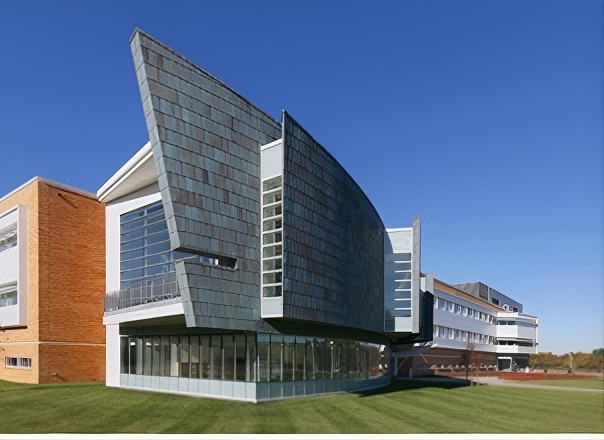
Our 400 m2 office and indoor laboratory spaces are located in the New York State Center of Excellence in Wireless and Information Technology (CEWIT) building at Stony Brook University. The office and indoor laboratory spaces feature state of the art computer and conference capabilities and access to a rooftop laboratory space for instrument testing. Computing facilities maintained by our research group include a total online server disc capacity of 350 TB. Our three main servers have a total processing power of 96 dual core processors, 5 GPU units and 2 TB RAM.

Radar Facilities

KASPR

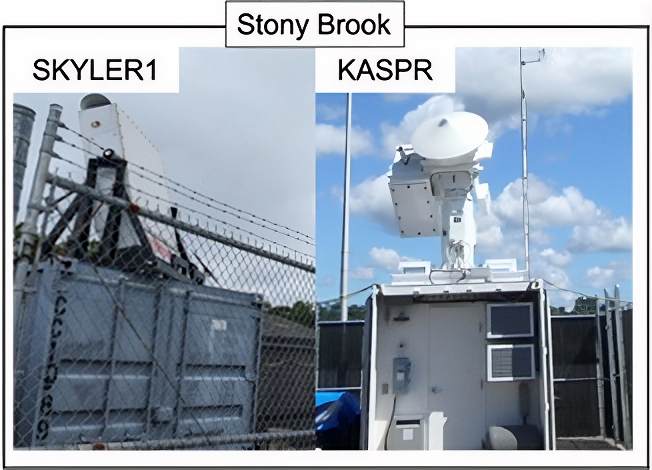
The flagship radar of the observatory is a 35-GHz (Ka-band, 8-mm) Scanning Polarimetric Radar (KASPR). KASPR, a state-of-the-art cloud scanning radar, can collect Doppler spectra and radar moments through alternate transmission of horizontally and vertically polarized waves and simultaneous reception of co-polar and cross-polar components of the backscattered wave with the beamwidth of 0.32°, hence a full set of polarimetric radar observables is available. These polarimetric observables allow us to identify microphysical processes.

The SBRO main facility features a SKYLER-I X-band Phased Array Radar (PAR) developed by Raytheon Technologies. The SKYLER-I radar has an antenna beamwidth of 1.98° in azimuth and 2.1° in elevation at boresight. The beam is electronically scanned in the horizontal plane by +/- 45° and in the vertical plane +/- 15° relative to the boresight. The radar transmits H- and V-polarization pulses (alternating) and provides estimates of ΦDP, KDP, ZDR, and ρHV in addition to the standard power and Doppler measurements.
A second generation (SKYLER-II) PAR system has been integrated onto a mobile platform (RAMS 550 with extended flatbed) for weather observations (Fig. 2). The SBU mobile radar truck is equipped with a generator, gas tank, helium rack, computer rack and KVM monitor and 5G router for off-the-grid operations. The dual-polarization, X-band, low-power, Phased- Array Radar (SKYLER-II uses an active electronically scanned antenna array comprising 2,560 transmit/receive channels (arranged in a 64×40 grid), each with individual amplitude, phase, and polarization control on both transmit and receive. The high duty cycle (20-22%) results in an average power of 23 W, thus providing sufficient sensitivity to observe convection (minimum of -5 dBZ at 10 km range). The radar has been configured to accommodate flexible waveform and scan diversity including waveform diversity, Pulse Repetition Frequency (PRF) diversity, frequency hopping within a 50-MHz band, and short and long pulse staggering at offset frequencies in various polarization transmit/receive modes such as single (HH or VV), alternating (HH, VV), and fully polarimetric (HH,HV,VV,VH). Pulse compression is implemented to achieve adequate sensitivity at long ranges. The antenna beamwidth is 1.98° in azimuth and 2.1° in elevation at boresight. The beam orientation in the horizontal plane is +/- 45° electronically scanned and the orientation in the vertical plane is 0° to 30°, relative to ground horizontal, electronically scanned. The radar transmits H- and V-polarization pulses (alternate) and provides estimates polarization in addition to the standard power and Doppler measurements.
SBRO operates a prototype dual-frequency X/Ku-band radar from Agile Radar Inc. that leverages a metamaterials antenna system for ground-based and airborne applications in precipitation and sea surface sensing. Nicknamed the Rain, Ocean, Atmospheric Radar System (ROARS), the radar utilizes a software-defined radar digital IF transceiver in concert with the e-steered beam controller to enable a variety of sampling modes (e.g., ground-based weather scans, airborne ocean surface vector wind scatterometry, sea surface altimetry), and a 100 W peak power, high duty cycle transmitter to realize high sensitivity (5 dBZ min reflectivity at 10 km) with a modest form factor (<1 m) aperture. The ability to scan the beam 60 degrees off of the array boresight in any direction and arbitrarily specify the linear polarization angle allows for significant sector scan coverage with pure H or V polarization. Furthermore, the operation of the system in a staggered-PRI mode and with a frequency-diverse combination of a short pulse and long linear frequency modulated pulse enables sensitive Doppler observations (pulse-pair and/or 2D spectra) with very short blind range and high effective unambiguous velocities utilizing standard unfolding methods. The ROARS system is deployed in Northern Alabama at one of the supplemental sites of the US Department of Energy Atmospheric Radiation Measurement (ARM) user facility deployment at the Bankhead National Forest (BNF).
kaspr skyler
software

Software

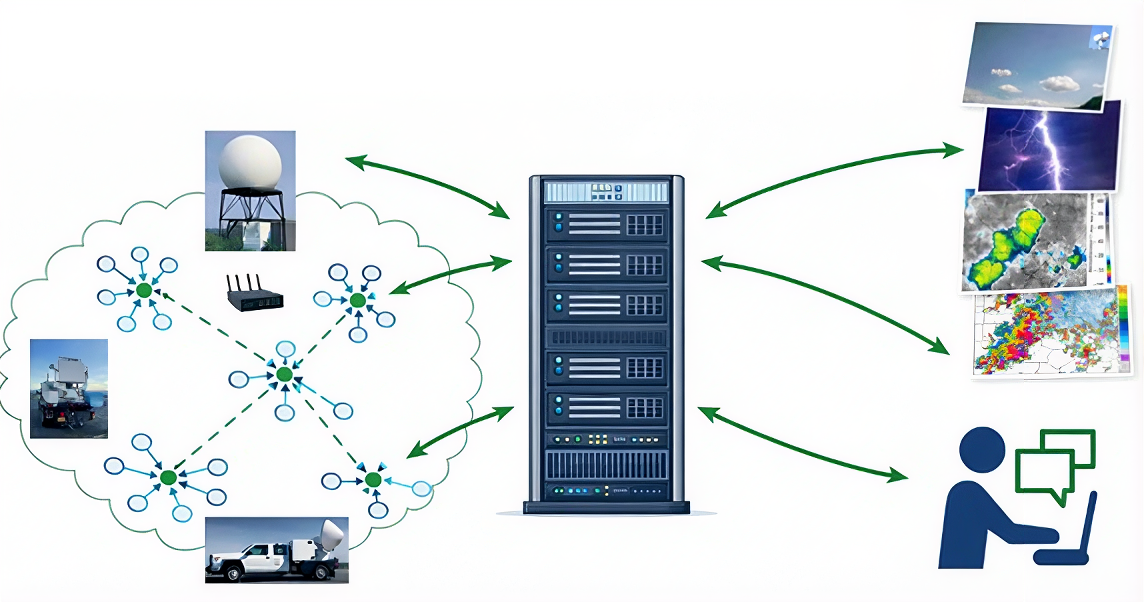
The Multisensor Agile Adaptive Sampling (MAAS, Kollias et al., 2020) cyberinfrastructure (CI), currently supported by the National Science Foundation Directorate for Computer and Information Science and Engineering (Kollias et al., 2020). The MAAS CI’s goal is to significantly improve the ability to sample rapidly evolving atmospheric phenomena by providing better control systems across multiple advanced radar systems (brown box, Figure 4). By better enabling the real-time, fine-grained, coordinated control of atmospheric observing instruments, the MAAS framework can revolutionize the study of convective storms towards the goal of improving our scientific understanding and the prediction of extreme or high-impact storms using physics-based and AI-based models. Transformative elements of the MAAS CI are the use of real-time observations external to the outdoor laboratory (blue box, Figure 4) for improved situational awareness and feature detection and tracking and its potential for integrating future observing technologies, such as drones and phased-array radars (Lamer et al., 2023).

CR-SIM (the Cloud-resolving model Radar SIMulator) is a forward-modeling framework that converts numerical weather prediction model output into synthetic radar observations by simulating electromagnetic scattering from model-resolved hydrometeors across multiple radar frequencies, polarizations, and viewing geometries (Oue et al., 2020). The simulator accounts for hydrometeor size distributions, phase-dependent dielectric properties, attenuation, and Doppler effects, enabling systematic evaluation of radar observables and sensing strategies; however, in its current form CR-SIM does not explicitly represent partially melted hydrometeors, instead treating ice and liquid species separately, which limits its ability to reproduce realistic melting-layer (bright band) radar signatures. CR-SIM is nevertheless widely used across the meteorological research community due to its open-source availability, modular design, and comprehensive documentation, which have facilitated broad adoption, reproducibility, and extension by both radar and modeling groups.